
Makerspaces
With the rapid development of technology, exploring more efficient and advanced teaching methods has become the goal of many teachers and students (Plus Company Updates, 2018). Makerspaces allow for the integration of STEM in the classroom in an authentic and engaging way, by creating for a purpose. It’s not creating something without meaning, it’s also about the application of the student’s design. It aims to encourage critical thinking and reflection from students by developing creative solutions to authentic problems. Creating authentic makerspaces in school will be challenging because the traditional school pedagogies and curriculum are in direct opposition to the kinds of learning that take place in makerspaces (Lindstrom, Thompson, & Schmidt-Crawford, 2017).
Constructionism
Papert’s Constructionism builds upon Piaget’s Constructivism and claims that the construction of knowledge occurs when students build, make and publicly share objects (Blinkstein, 2013). It is a learning theory where learning is predicated from the active construction of a shareable artefact (Martinez & Stager, 2019). Teachers act as facilitators in an environment where students are actively making instead of being passive recipients of instruction. It permits the acknowledgement and embracing of different learning styles and epistemologies, creating a friendly environment in which students can construct their ideas and projects with intense personal engagement (Blinkstein, 2013). Technology in schools is not a way to optimise traditional education, but rather it is an emancipatory tool that puts the most powerful construction materials in the hands of children (Blinkstein, 2013). These open-ended tasks foster creativity by allowing students to design something however they like.
Makeblock Neuron
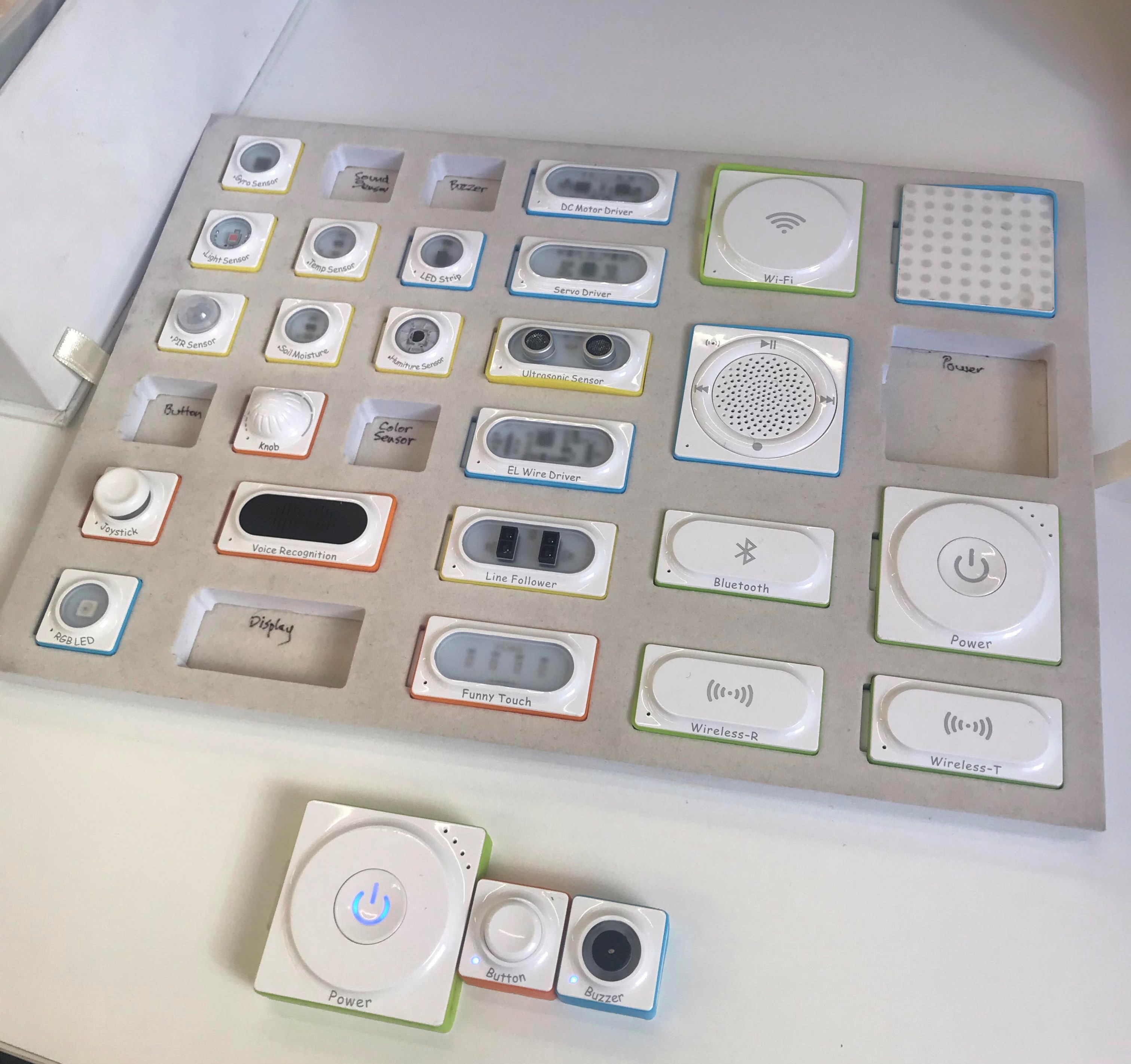
Makeblock Neuron was designed as a smart electronic block platform to help children play games, invent tools and DIY gadgets, learn programming and encourage teamwork while playing (Wireless News, 2018). Makeblock Neuron affords opportunities to inspire creativity and ingenuity in children. Visual feedback from the hardware is immediate, making it easy for children to see if their design worked as planned. The education product empowers children to be creative in an intuitive manner. Makeblock Neuron allows for invention to be easier and faster, expanding the opportunity for out-of-the-box creation for children (Wireless News, 2018). There are more than 30 unique coloured modules, like power sources and sensors, inputs and outputs for children to easily identify and manipulate (Wireless News, 2018). These modules can be combined with themselves or other everyday materials to solve authentic problems.
References
Blikstein, P. (2013). Digital fabrication and ‘making’ in education: The democratization of invention. FabLabs: Of Machines, Makers and Inventors
Lindstrom, D., Thompson, A.D., & Schmidt-Crawford, D.A. (2017). The maker movement: democratizing STEM education and empowering learners to shape their world. Journal of Digital Learning in Teacher Education, 33(3).
Martinez, S., & Stager, G. (2019). The maker movement: A learning revolution. International Society for Technology in Education. Available at: https://www.iste.org/explore/articleDetail?articleid=106
Plus Company Updates. (2018). Makeblock Neuron Wins 2018 Gold Edison Awards.
TEDx Talks. (2015). Makerspace: Make Community | Jamie Leben | TEDxFrontRange [Video]. Retrieved from https://www.youtube.com/watch?v=CQnXaShzuHw
Wireless News. (2018). Makeblock Neuron Gets 2018 Gold Edison Awards.
 A Conversation: Digital Creativity and Learning
Thank you for introducing me to this wonderful new technology! I found your comments regarding how technology shouldn’t be viewed as a tool to optimise traditional education very interesting, especially in the context of constructionism. I also think that having students engage in open-ended tasks while constructing something for an authentic purpose would definitely encourage critical thinking skills and teamwork abilities.
You mentioned in your post that using Makeblock Neuron would encourage creativity. I would like to get your thoughts on how to further integrate the use of this emerging technology into a lesson. Would you use the Makeblock Neuron only for Science and Technology lessons, where you would challenge students to the use the modules to create something that solve an authentic problem? Or would you think that it would be more suited to other KLAs?
All in all, thanks for the insightful post.
LikeLike