
Scratch is a free visual programming language aimed at children who are learning to program. Scratch turns children from media consumers into media producers, enabling them to create their own interactive stories, games, music, and animations (Schorow, 2007). Scratch helps young people learn 21st Century skills, including how to think creatively, reason systematically and work collaboratively.
Children construct knowledge based on active engagement in learning experiences (Lamb & Johnson, 2011). Scratch allows children to be actively engaged when learning to write programs based on their interests. A student may have a passion for cars and therefore constructs knowledge by programming a car to move around. Another student may have a story to tell, but struggles to express themselves on paper. Instead they could write a program to tell that story.
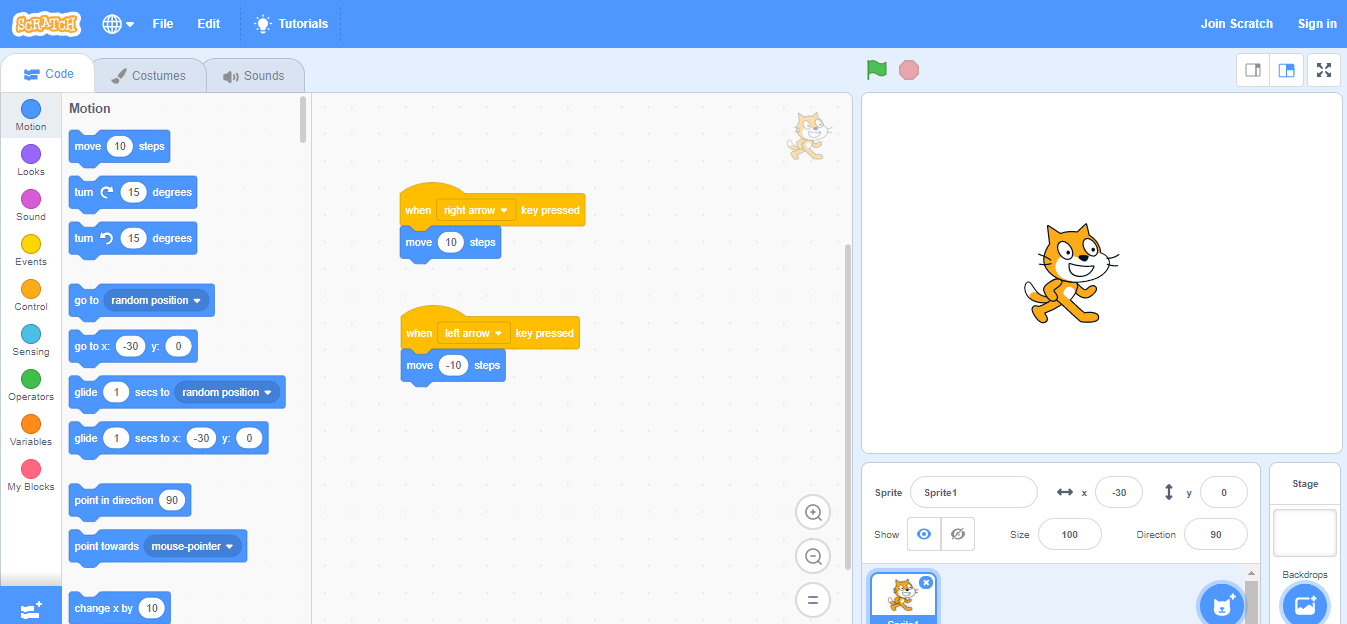
Tools like Scratch can empower students to express their creativity like never before; however, the way these tools are taught by teachers and used by students significantly influences whether students move along the creativity continuum (Yadav & Cooper, 2017). Fortunately, the Scratch software is intuitive for beginners. This ease-of-use allows students to focus on language development, creativity, logic, reasoning and problem-solving, rather than learning how to use the tool itself (Lamb & Johnson, 2011).
The website lets users blend together different media (including graphics, sound, and other programs) in creative ways by “remixing” projects (Schorow, 2007). There is a strong emphasis on downloading other people’s work and users creating their own derivative. By sharing their work, students could discover their own mistakes and learn effective or better solution methods from others (Chiang & Qin, 2018). It allows for more opportunities to debug any issues in the programming. The creation of games by students can be a co-operative learning activity or an individual activity. It provides a lot of opportunity for students to showcase their program design and share them with their friends.
Learning basic programming from a platform like Scratch has a wide range of benefits. It is highly motivating for students and empowers them to pursue their studies in programming (Ouahbi, Kaddari, Darhmaoui, Elachqar & Lahmine, 2015). This study (2015) found that 65% of students who have experienced Scratch would consider continuing programming, compared to 10% who used a standard programming platform. Chiang and Qin (2018) found significant improvements in students’ equation-solving performance and in their attitudes towards learning mathematics with the assistance of technology.
Often children play video games after doing their homework. Now imagine a world where playing and creating video games is the assigned homework.
Games Created with Scratch
References
Chiang, F., & Qin, L. (2018). A Pilot study to assess the impacts of game-based construction learning, using scratch, on students’ multi-step equation-solving performance. Interactive Learning Environments, 26(6).
Lamb, A., & Johnson, L. (2011). Scratch: Computer Programming for 21st Century Learners. Teacher Librarian, 38(4).
MIT Scratch Team. (2019). Scratch! [Video]. Retrieved from https://www.youtube.com/watch?v=98awWpkx9UM
Ouahbi, I., Kaddari, F., Darhmaoui, H., Elachqar, A., & Lahmine, S. (2015). Learning Basic Programming Concepts by Creating Games with Scratch Programming Environment. Procedia – Social And Behavioral Sciences, 191.
Yadav, A., & Cooper, S. (2017). Fostering creativity through computing. Communications Of The ACM, 60(2).
 A Conversation: Digital Creativity and Learning