
Augmented reality is technology that projects digital materials onto real world objects (Cuendet et al., 2013). It is well suited to the nurturing of creativity and imagination. Textbooks and flashcards may contain embedded markers, that when scanned by a tablet, produce additional multimedia information. Augmented reality encourages student engagement in authentic exploration of the real world and increases motivation (Wu et al., 2013). Instead of remaining passive recipients, students can become active learners and interact with their learning environment by turning simple tasks into creative playgrounds.
Augmented creativity is children interacting with the physical environment in a playful and creative way. It provides magical digital overlays on top of tradition real-world creative activities. It can be used to enhance creativity in a number of ways by using a tablet.
- The first demonstration includes a blank colouring-in page of a woman. When the student colours in her dress, it dynamically projects it onto the 3D representation of the woman.
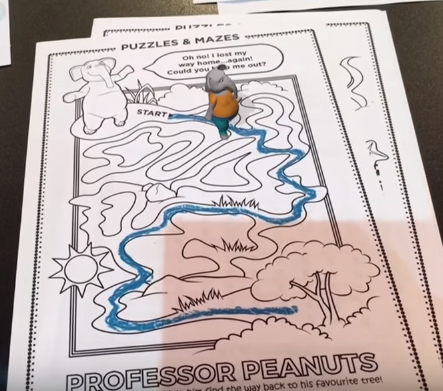
- A student completes a maze. A 3D character is then projected onto the maze and walks from start to finish. The system validates that the maze was correct.
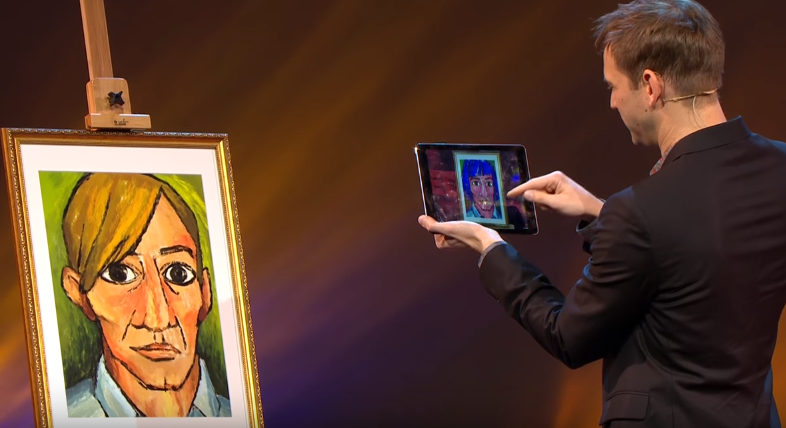
- The tablet is pointed at a portrait and then can be edited by changing the colours, hair style, size of eyes or nose, etc.
- A teacher stamps a student’s work. The tablet recognises the mark on the paper and projects the corresponding character onto the screen. The characters can also battle each other for added student engagement.

Augmented reality doesn’t have to be solely visual, it can also be audial. An activity could be used to enhance the creativity in students and give an introduction to the styles of music and instruments. Several cards are placed on the table with different instruments and musical styles printed on them. Instead of students passively listening to music styles, they can mix the music to actively learn by creating different sounds.

Criticisms
A lack of training to provide the necessary skills may force teachers to struggle to put the augmented reality technology into practice. Teachers, schools and their leaders must be very open-minded to apply augmented reality to education. As tablets can be quite expensive, not all schools will have the necessary number to accommodate their students. The tasks may be too open-ended and would require explicit guidelines set out by the teacher.
References
Cuendet, S., Bonnard, Q., Do-Lenh, S., & Dillenbourg, P. (2013). Designing augmented reality for the classroom. Computers & Education, 68, 557-569.
Sumner, B. (2017). Augmented Creativity | Bob Sumner | TEDxZurich [Video]. Retrieved from https://www.youtube.com/watch?time_continue=217&v=AJJOWemfOYI
Wu, H.-K., Lee, S. W.-Y., Chang, H.-Y., & Liang, J.-C. (2013). Current status, opportunities and challenges of augmented reality in education. Computers & Education, 62, 41-49.
 A Conversation: Digital Creativity and Learning
Hi Jordan! A fantastic overview of how Augmented Reality could be used in the classroom. I especially enjoyed the dot point lesson suggestions, it really brought the technology into context. Citing a specific Augmented Reality software or game could have provided some additional context and guidance for teachers. The inclusion of a Tedx talk really expanded on your assessment of the technology. This was an interesting read, thank you and good work!
LikeLike